
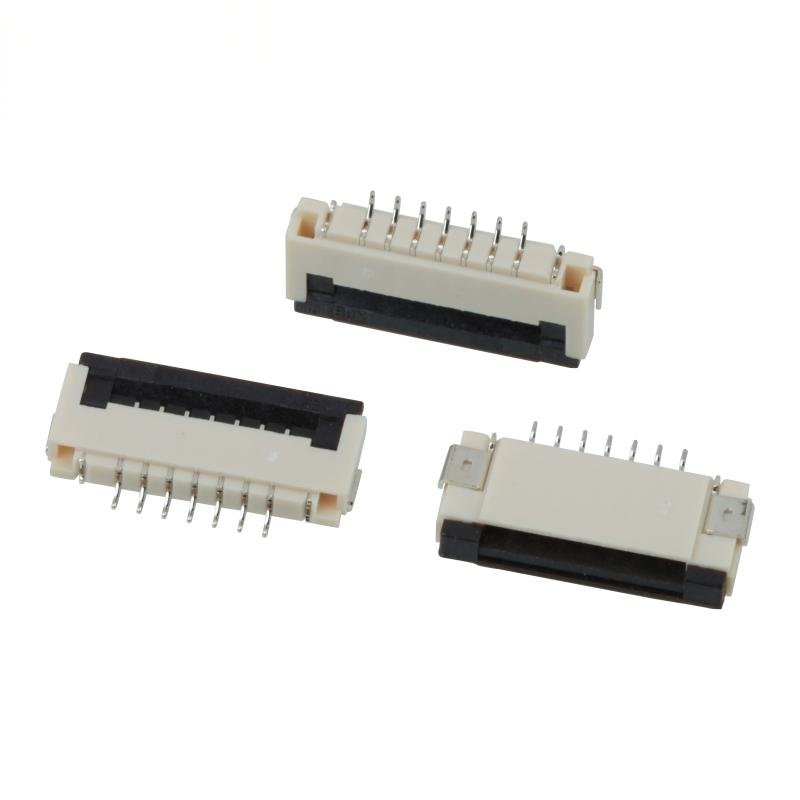
SMT connectors (surface mount technology connectors) have significant advantages over traditional through hole (THT) connectors in modern electronic manufacturing, especially suitable for high-density, miniaturized, and automated production scenarios. According to authoritative public information, its core advantages can be summarized as follows:
Main advantages
Small size and light weight: SMT connectors do not require drilling and can be directly mounted on the surface of PCBs. The volume and weight of the components are only 1/10~1/5 of THT components, which helps to achieve device lightweighting.
High assembly density: saves PCB space, supports higher component layout density, reduces the area of modern mobile phone motherboards by more than 70%, but increases the number of integrated components by 10 times.
High degree of automation: compatible with high-speed surface mount machines and reflow soldering processes, a single SMT production line can produce 50000 to 100000 PCBs per day, which is 20 to 50 times more than THT manual insertion.
Strong reliability: Short pins, no through holes, excellent shock resistance, solder joint defect rate one order of magnitude lower than THT, and significantly reduced failure rate.
Good high-frequency performance: small parasitic inductance and capacitance, low electromagnetic interference (EMI), suitable for high-speed signal transmission.
High cost-effectiveness: By reducing PCB drilling, saving materials, and lowering labor and maintenance costs, the overall product cost can be reduced by 30% to 50%.
Compatible with advanced processes: Supports lead-free soldering, RoHS compliance, suitable for high reliability fields such as automotive electronics, medical equipment, 5G communication, etc.